Annotating a text is a very old practice. Medieval manuscripts are covered in glosses, and the most famous margin note in the history of mathematics is the one where Fermat regrets that the margin is too narrow.
I have discovered a truly marvelous proof of this, which this margin is too narrow to contain.
The proposition in question: for any integer \( n > 2 \), there are no strictly positive integers such that
\[ x^n + y^n = z^n \]
Annotation isn't only a way of keeping a trace. It changes how you read.
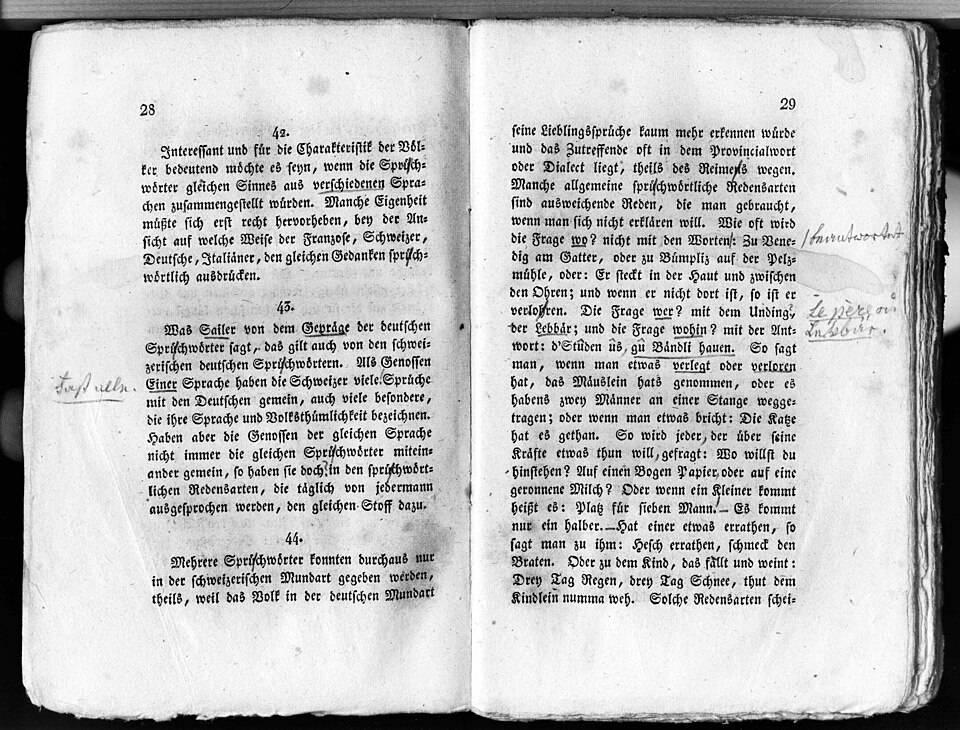
Source: Melchior Kirchhofer, Wikimedia Commons, Public domain.

Highlighting isn't enough
Highlighting gives a feeling of work done. Research on learning is rather severe about it: rereading or highlighting alone does little for long-term memory. A well-known 2013 review by John Dunlosky and colleagues ranks highlighting among the less useful techniques.
The problem is that you can highlight without thinking. The color goes over the sentence, the idea doesn't go through your head.
Write in your own words
What helps is effort. Rephrasing an idea, connecting it to what you already know, asking whether you agree. A three-word note in the margin, like "contradicts X" or "example for the project", is worth more than two yellow paragraphs.
Asking yourself a question while reading, then trying to answer without looking at the text, works even better. It's called active recall, and it is one of the best established methods we have.
Less, but better
Try to limit yourself to a few passages per article. If everything is important, nothing is, and you will never reread a fully colored page. Waiting until the end of a paragraph before marking anything also helps: you can see what actually mattered.
Coming back to your notes
An annotation only has value if you see it again. That is the whole point of sociologist Niklas Luhmann's Zettelkasten: each note is written to be found and connected to others.
The forgetting curve described by Hermann Ebbinghaus in the late 19th century is often summed up as an exponential, where \( R \) is what remains in memory after a time \( t \), and \( S \) the strength of the memory:
\[ R = e^{-t/S} \]
You don't need to go that far. Once a month, go back over what you annotated and keep one or two ideas. That is usually when you understand why you set that passage aside.
A tool in the service of reading
It's easy to get absorbed by the system: colors, tags, note templates, graphs connecting thousands of cards. If your method demands more effort than the texts themselves, simplify it. A pencil, a margin and one or two honest questions have long proven their worth.
Four ways to annotate
There is no single right way, and it all depends on what you want from the text. Annotating to understand, first: you note what resists, the term to check, the reasoning you couldn't follow. These notes are often questions, and they are perfectly entitled to stay unanswered for a while.
Annotating to argue, next. You write down your disagreement, you bring in another author, you point out the example that doesn't fit. These are the most interesting notes to reread, because they say what you thought at the time, and sometimes how much you have changed your mind since.
Annotating to reuse means setting aside a quotation, a figure or a reference for work in progress. In that case, say right away what it is for. "For the March presentation" is far more useful than a simple line in the margin.
Annotating to pass on, finally: you prepare a passage to show someone. The note then speaks to a specific reader, which forces you to be clear.
Reading a difficult text
Faced with a demanding text, the temptation is to underline everything, since everything seems important. Try a first, fairly quick reading with no pencil, to see where the author is going. Then return to the start and annotate, knowing the destination. You will tell the main argument from its illustrations, which is almost impossible on a first reading.
At the end of each section, write in one sentence what you take from it, without looking. If you can't, that isn't a failure: you have just learned where to reread.
Paper or screen
Comparisons between reading on paper and on screen give nuanced results. For long informational texts, several syntheses observe a slight advantage for paper, especially when time is limited. The most common explanation has less to do with the screen than with our habits: we read faster and more superficially on a device associated with messages and notifications.
The screen gets its revenge elsewhere: you can search your notes, copy them, sort them and export them. The most sensible thing is probably not to choose once and for all.